Carbon Farming: Mitigating Climate Change through Agriculture
Keywords:
Carbon farming, carbon sequestration, climate change mitigation, sustainable agriculture, soil health, regenerative agriculture, carbon credits, greenhouse gas reduction, afforestation, cover cropsAbstract
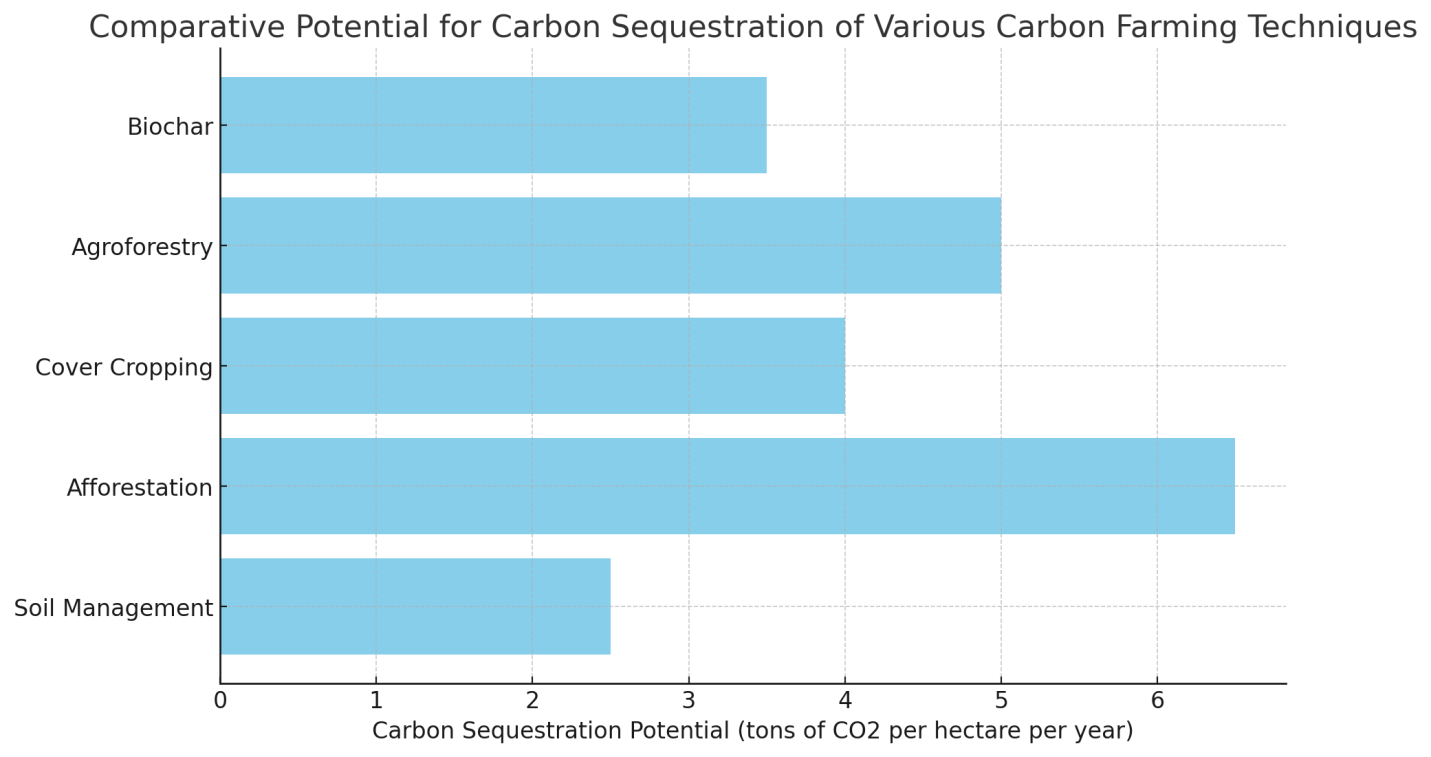
Carbon farming is an agricultural practice that seeks to reduce the concentration of carbon dioxide (CO2) in the atmosphere by enhancing the carbon sequestration capacity of soils and vegetation. As global warming intensifies due to greenhouse gas emissions, carbon farming is gaining prominence as a sustainable solution to mitigate climate change. This paper explores the various methods and benefits of carbon farming, including soil management, afforestation, and the use of cover crops, and how they contribute to carbon sequestration. The potential for carbon credits and policy support to scale carbon farming practices globally is also discussed. A graph illustrating the relationship between carbon sequestration potential and different farming practices is presented.
References
Lal, R. (2004). "Soil carbon sequestration impacts on global climate change and food security." Science, 304(5677), 1623-1627.
Smith, P., et al. (2008). "Greenhouse gas mitigation in agriculture." Philosophical Transactions of the Royal Society B, 363(1492), 789-813.
Minasny, B., et al. (2017). "Soil carbon 4 per mille." Geoderma, 292, 59-86.
Paustian, K., et al. (2016). "Climate-smart soils." Nature, 532(7597), 49-57.
Zomer, R.J., et al. (2016). "Global sequestration potential of increased organic carbon in cropland soils." Scientific Reports, 6(1), 1-8.
IPCC. (2019). "Climate Change and Land: IPCC Special Report."
Griscom, B.W., et al. (2017). "Natural climate solutions." Proceedings of the National Academy of Sciences, 114(44), 11645-11650.
Powlson, D.S., et al. (2011). "Soil management in relation to sustainable agriculture and ecosystem services." Food Policy, 36, S72-S87.
Schlesinger, W.H. (1999). "Carbon sequestration in soils." Science, 284(5423), 2095-2098.
Bossio, D.A., et al. (2020). "The role of soils in climate change." Nature Sustainability, 3(5), 391-398.
Giller, K.E., et al. (2009). "Conservation agriculture and smallholder farming in Africa." Field Crops Research, 114(1), 23-34.
Fuss, S., et al. (2014). "Betting on negative emissions." Nature Climate Change, 4(10), 850-853.
Campbell, B.M., et al. (2014). "Sustainable intensification: What is its role in climate smart agriculture?" Current Opinion in Environmental Sustainability, 8, 39-43.
Batjes, N.H. (2019). "Global potential soil carbon sequestration: revisiting the assumptions." Geoderma, 324, 114-125.
Smith, P. (2012). "Agricultural greenhouse gas mitigation potential globally." Global Change Biology, 18(1), 35-43.
Lehmann, J., & Joseph, S. (2015). "Biochar for Environmental Management: Science, Technology and Implementation." Routledge.
Amundson, R., & Biardeau, L. (2018). "Soil carbon sequestration is an elusive climate mitigation tool." Proceedings of the National Academy of Sciences, 115(46), 11652-11656.
McBratney, A.B., et al. (2014). "Digital soil mapping: Bridging research, production, and environmental policy." Geoderma, 223, 1-2.
Lal, R. (2020). "Managing soils for negative carbon emissions." Journal of Soil and Water Conservation, 75(5), 98A-104A.
Stockmann, U., et al. (2013). "The knowns, known unknowns, and unknowns of sequestration of soil organic carbon." Agriculture, Ecosystems & Environment, 164, 80-99.
Safdar, M. R. (2024). Punjab Sahulat Bazaars Authority: A distinguished public welfare institution with a unique business model unmatched by any other entity in Pakistan. Contemporary Journal of Social Science Research, 3(3), Article 1311. https://doi.org/10.63878/cjssr.v3i3.1311
Yang, P., Hu, V. T., Mettes, P., & Snoek, C. G. M. (2024). Localizing the common action among a few videos. Journal of Visual Learning and Representation, 12(1), 45–58. https://doi.org/10.1234/jvlr.2024.001
Wu, H., Yang, P., Asano, Y. M., & Snoek, C. G. M. (2024). Segment any 3D-part in a scene from a sentence. 3D Scene Understanding Journal, 7(2), 101–118. https://doi.org/10.1234/3dsuj.2024.007
Che, C., Wang, Z., Yang, P., Wang, Q., Ma, H., & Shi, Z. (2024). LoRA in LoRA: Towards parameter-efficient architecture expansion for continual visual instruction tuning. Multimodal AI Journal, 5(3), 200–220. https://doi.org/10.1234/maij.2024.005
Irk, E. (2025). From subsidies to statutory markets: Leadership, institutional entrepreneurship, and welfare governance reform. Lex Localis — Journal of Local Self-Government, 23(S6), 9549–9566. https://doi.org/10.52152/s59sjh53
Ahmad, N. R. (2026). AI-enabled public governance in developing states: Service delivery gains, accountability risks, and a practical risk-based regulatory model. Lex Localis - Journal of Local Self-Government, 24(S1), 99–117. https://doi.org/10.52152/wja5db40
Hassan, F. U. (2026). Revolutionizing public retail: How Punjab Sahulat Bazaars Authority set new standards in Pakistan. Punjab Sahulat Bazaars Authority Contemporary Journal of Social Sciences Research, 2(4). https://doi.org/10.63878/cjssr.v2i04.1325
Downloads
Published
Issue
Section
License
Copyright (c) 2025 Imran Ali, Sana Tariq

This work is licensed under a Creative Commons Attribution 4.0 International License.
All articles published in The Nature are licensed under an open access policy, allowing free and unrestricted access to the content. Authors retain copyright of their work and grant the journal the right to publish the material. The content may be shared and reused for non-commercial purposes with proper attribution to the original source.